How AI Is Changing Tennis Coaching for Junior Players
What AI actually does well in tennis coaching today, what peer-reviewed research says about athlete adoption and safety limits, and where human coaches remain irreplaceable.

How AI Is Changing Tennis Coaching for Junior Players
Ten years ago, the kind of feedback a player got on their serve depended almost entirely on one thing: how good an eye the coach standing on the other side of the net happened to have. That's still true today for the vast majority of junior players. But a growing layer of AI-driven tools is starting to change what "coaching" actually means — not by replacing the coach, but by giving both the coach and the player something neither had reliable access to before: consistent, objective feedback between sessions.
Here's an honest look at what AI is actually doing in tennis coaching right now, what the research says about how athletes respond to it, and where the real limitations still are.
Why This Shift Is Happening Now
Data analytics has quietly been part of professional sports coaching for at least three decades, but it stayed largely confined to elite programs with dedicated analytics staff and expensive tracking hardware. What's changed recently is access. A smartphone camera combined with modern computer vision and machine learning can now do a version of what used to require a specialized lab setup — tracking a serve toss, a swing path, a ball's trajectory — cheaply enough that an individual junior player's family can use it, not just a national federation's high performance center.
A 2024 systematic review of the academic literature on AI in digital sports coaching found that this technology increasingly supports specific coaching functions directly — not just data collection, but analysis and feedback generation that used to require a human expert in the loop for every step. The same review noted that research in this area has so far focused mostly on isolated case studies rather than a comprehensive picture, which is itself a sign of how new and fast-moving this space still is.
What AI Actually Does Well in Tennis Coaching Today
1. Consistent, Repeatable Technique Feedback
The most immediate value AI brings to junior tennis is consistency. A human coach's read on a serve motion can vary slightly session to session, especially across different coaches at an academy, or when a family relies on video calls with a remote coach who only sees isolated clips. An AI system trained on movement patterns applies the same evaluation criteria every time, which makes it easier to isolate whether a change in performance reflects an actual technical shift, or just a different pair of eyes watching.
2. Catching What's Hard to See in Real Time
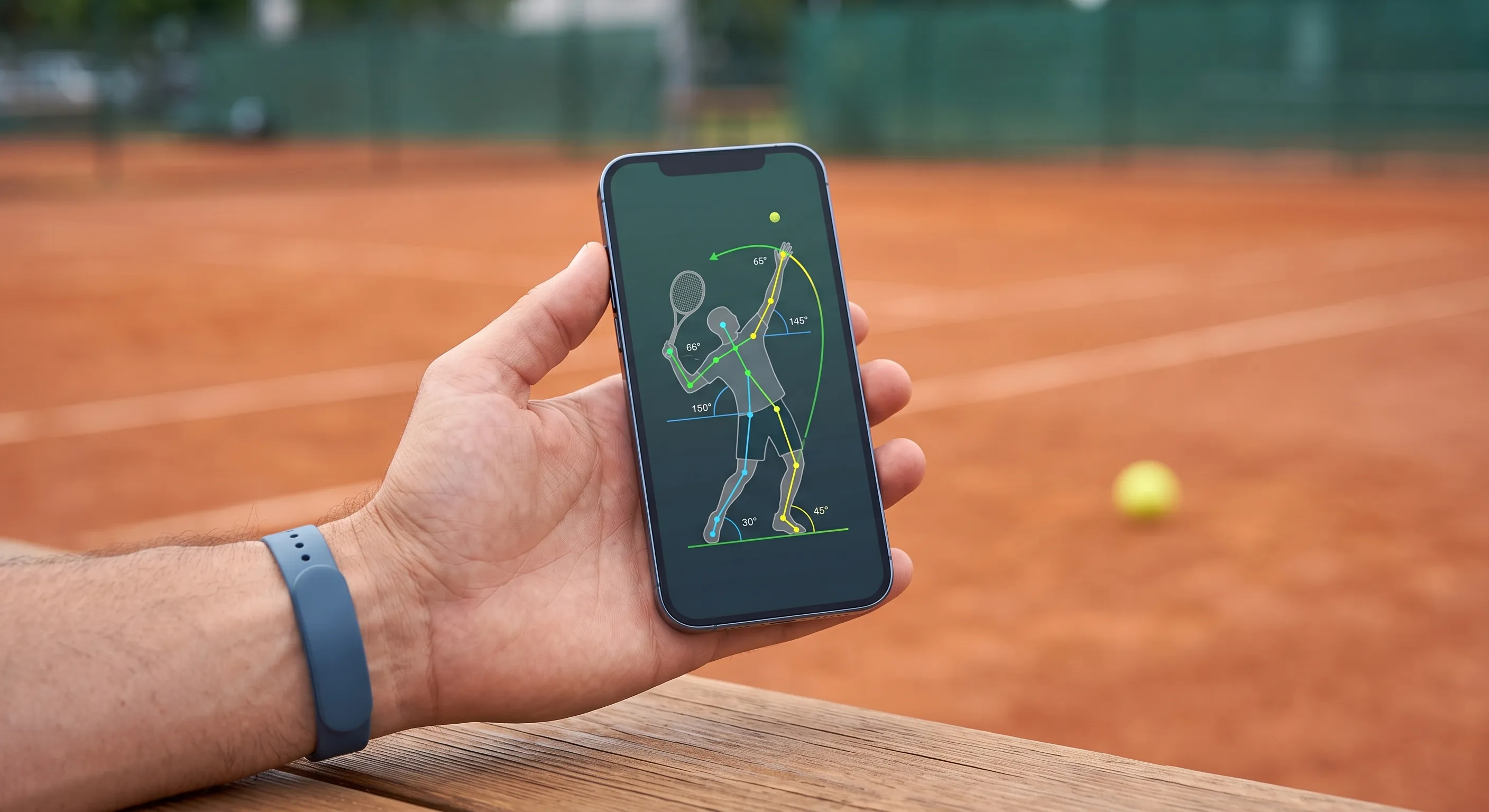
A toss that drifts three inches to the left, a contact point that's crept slightly behind the body, a follow-through that's shortening under fatigue — these are the kinds of subtle mechanical drifts that are genuinely difficult to catch with the naked eye during live play, especially at full speed. Frame-by-frame AI analysis of video makes these visible in a way that live observation often can't.
3. Personalization at a Scale No Individual Coach Can Match
A qualitative study interviewing athletes across various sports about their experience with AI-driven coaching technologies identified enhanced training efficiency, personalization, and injury prevention among the clearest perceived benefits. Athletes in that study specifically pointed to how AI tools adapted feedback and recommendations to their individual patterns over time, something that's difficult for a coach juggling a full roster of players to do with the same depth for every single athlete.
4. Removing Friction From the Practice-to-Feedback Loop
Traditionally, technique review meant scheduling time with a coach, often after the fact, to go over video from a lesson or match. AI-assisted tools collapse that loop: upload a clip after practice, get a breakdown within minutes, and bring specific questions to the next coaching session instead of a vague "does my serve look okay?"
What the Research Says About How Athletes Actually Respond
It's worth being honest here rather than just promotional: the research on AI coaching adoption is still young, and it surfaces real nuance, not unconditional enthusiasm.
The same qualitative athlete study mentioned above identified adoption and adaptation as a distinct theme — athletes don't uniformly embrace these tools immediately. Successful adoption depended on the technology being genuinely easy to use, and, importantly, on maintaining the human element of coaching rather than replacing it. Athletes in the study explicitly flagged the need for better integration between AI feedback and the human coaching relationship, not a substitution of one for the other.
A separate pilot study on the psychological and perceptual factors behind AI-driven sports coaches raised a more pointed concern: the researchers noted that AI-generated training recommendations which exceed an athlete's physical limits, or which propagate incorrect technique, represent a real safety risk that isn't yet fully addressed in current systems. In practical terms, this is a strong argument for treating AI technique feedback as a tool a coach and player use together, rather than a fully autonomous replacement for professional judgment — especially for growing junior athletes, where overcorrecting a movement pattern without expert oversight carries real injury risk.
Where AI Genuinely Helps Junior Players (Not Just Pros)
Junior tennis has a specific problem that AI tools are unusually well suited to solve: most competitive juniors don't have daily access to a high-level coach watching every session. They might see their primary coach two or three times a week, with the rest of their practice happening on their own, with a hitting partner, or with a parent who isn't a tennis specialist.
This is exactly the gap AI-assisted technique analysis fills well. A player can record a serve during independent practice, get immediate feedback on toss consistency or racket path, and bring specific, concrete questions to the next lesson — rather than a coach starting from scratch trying to remember or guess what's changed since the last session.
The same applies to match play. Reviewing win rate trends, first serve percentage, and unforced error patterns across many matches — not just the last one — surfaces patterns a coach meeting a player for an hour a week would otherwise have to piece together from memory or a parent's secondhand account of how a tournament went.
Where the Limits Still Are
It's worth being direct about what AI coaching tools don't do, at least not yet.
They don't replace tactical and strategic coaching. Reading an opponent's patterns mid-match, adjusting a game plan on the fly, managing a player's mental state during a tight third set — this remains squarely in human coaching territory. AI tools are strongest on mechanics and data, not real-time tactical judgment.
They require a human in the loop for safety. As the research above notes, AI-generated technique recommendations aren't infallible, and applying them without a qualified coach reviewing the bigger picture carries real risk, particularly for junior athletes whose bodies are still developing. AI feedback works best as an input to a coaching relationship, not a replacement for one.
Data quality depends on video quality. Analysis is only as good as the footage it's working from — poor lighting, awkward camera angles, or a shaky handheld shot all degrade the accuracy of technique feedback, which is worth keeping in mind when recording practice clips.
What This Means Practically for a Tennis Family
The realistic way to think about AI in junior tennis coaching right now isn't "AI coach replaces human coach." It's a genuinely useful layer that sits between coaching sessions — catching drift in technique early, generating objective stats a coach doesn't have time to compile manually, and giving a player specific things to work on independently, so the time with a human coach goes further.
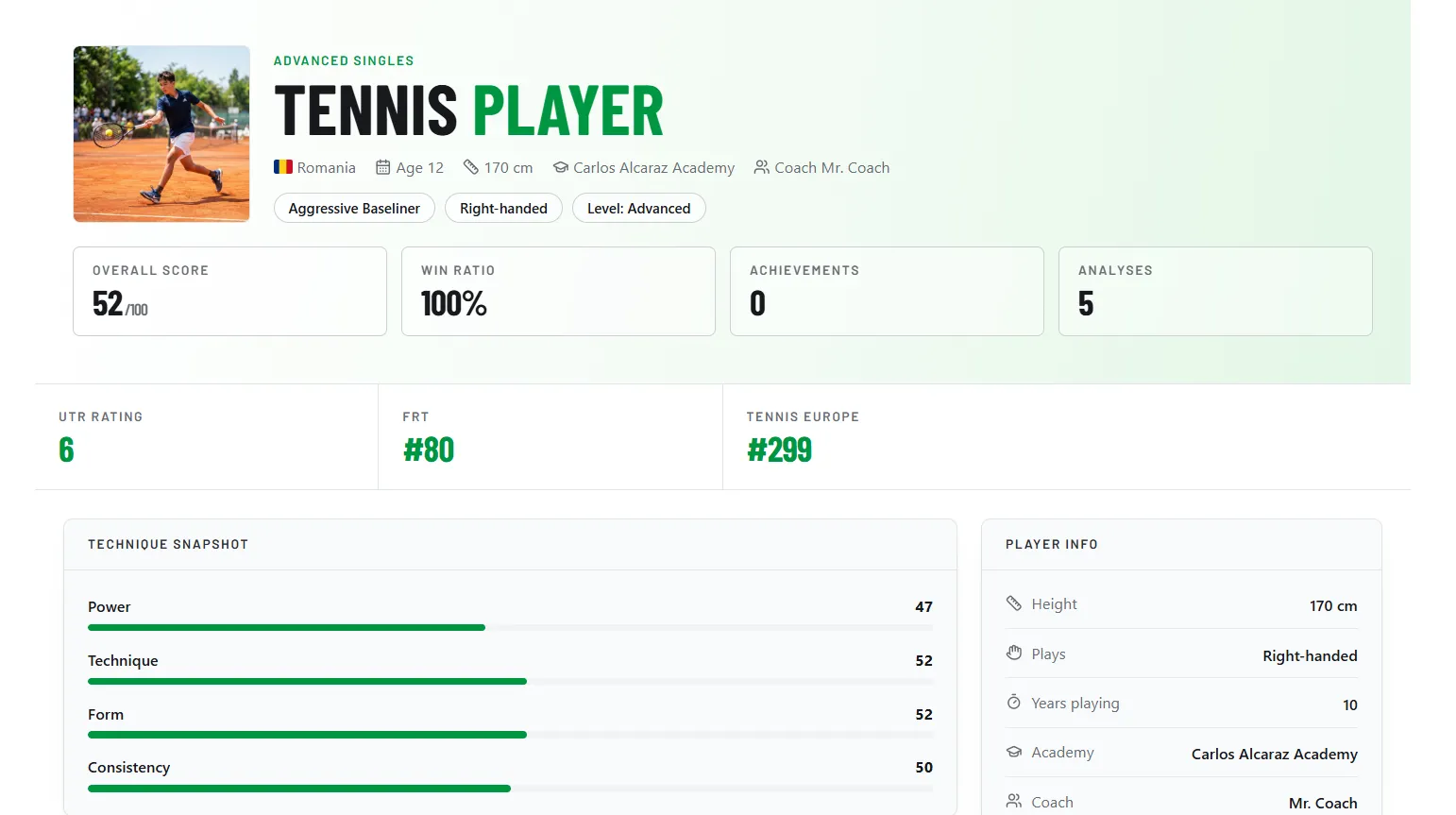
This is the exact gap the TennisDex dashboard is built around. Upload a clip of a serve, forehand, or backhand and get an AI-generated breakdown of the mechanics — power, form, footwork, consistency — scored individually, alongside match stats and progress tracked over months. It doesn't replace a coach's judgment; it gives the coach and player a consistent, objective starting point for every conversation between sessions.
Get AI feedback on your technique between coaching sessions — free.
Upload a clip, get a technique breakdown, and bring specific questions to your next lesson instead of guessing what's changed.
Try AI Technique Analysis FreeWhat to Look for in an AI Coaching Tool
Given the research above, a few practical criteria matter more than flashy features when evaluating any AI-assisted coaching tool for a junior player:
- Does it complement a coach rather than replace one? The strongest use case is a tool that gives a coach more to work with, not one that positions itself as a substitute for professional instruction.
- Is the feedback specific and actionable? Vague scores without concrete recommendations ("your technique is 72%") are far less useful than a specific note like "footwork lags on the split-step timing."
- Does it track change over time, not just a single snapshot? A single AI-generated report is a data point. A trend across weeks or months is what actually shows whether something is improving.
- Is video quality guidance built in? Tools that prompt for consistent camera angle and lighting produce more reliable feedback than ones that accept any clip without guidance.
Where to Learn More
- AI in Digital Sports Coaching: A Systematic Review — Managing Sport and Leisure, peer-reviewed academic literature review
- Characteristics and Perceived Suitability of AI-Driven Sports Coaches — peer-reviewed pilot study on psychological and safety factors, National Institutes of Health (PMC)
- Technology Adoption Model Applied to AI Fitness Services — peer-reviewed study, National Institutes of Health (PMC)
- Curious what tools exist today for technique analysis specifically? See Best Free Apps to Analyze Your Tennis Serve Technique